You finally decide to give your dating app profile a real upgrade, determined to stand out in the sea of swipe fatigue. But the moment you open those prompt fields, it’s déjà vu all over again: “I love to travel,” “My perfect weekend: Netflix and brunch,” “Looking for someone easygoing.” You fill them out, hit save, and deep down you know you’ve just joined the chorus of generic answers that all blend together.
If you’ve ever stared at these questions, convinced it’s impossible to write something that actually sparks a real conversation, you’re not alone—this block happens to just about everyone.
It’s not a creativity problem. Most people don’t realize what really makes a difference. They assume prompts don’t matter, that only the photos count, and that’s where so many interesting connections slip away.
Why Prompts Matter More Than Most People Think
There’s a myth that pictures do all the heavy lifting on dating apps. But in reality, prompts pack as much punch as six photos when it comes to engagement. That’s not a wild guess—recent data shows people who fill out all three prompt fields get twice as many matches compared to profiles that leave them blank or stick to cookie-cutter phrases.
The impact goes beyond match counts. When someone comments on a prompt answer, you’re three times more likely to get a reply than from a simple photo like. That detail is easy to miss: real conversations usually kick off with a witty prompt or a quirky detail, not just a beach selfie.
If you skip prompts or fill them out on autopilot thinking no one reads them, you’re basically missing your best shot at showing who you are—and at getting messages that go beyond “hey.” Treat these fields like your shop window, not a form you have to fill out just to get by.
From my own experience, whenever I spent more time crafting prompt answers than perfecting my photos, I saw a real difference: longer chats, messages with specific questions, and way fewer “ghosts” who vanish without a word. What really makes a profile pop is the effort to share something real and specific.
The Three-Step Formula for Answers That Stand Out
What turns a forgettable answer into one that actually “pops”? Structure.
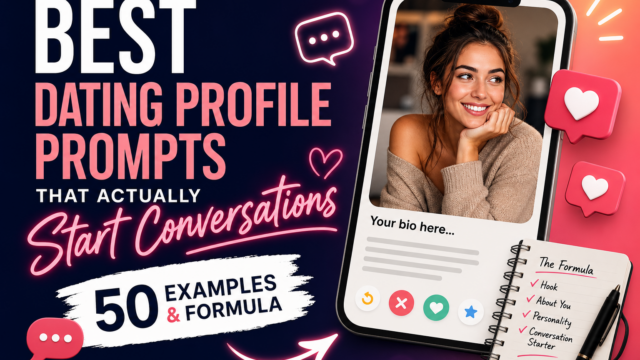
The best profiles follow a simple three-part formula: claim, detail, and hook. Or in plain English, a specific detail, a dash of surprise or tension, and some kind of open door for interaction—sometimes subtle, sometimes direct.
Take the classic prompt, “My little pleasures…” A dull answer: “Morning coffee.” Anyone could say that. Add a detail—“Strong coffee with cinnamon and cheese bread, jazz playlist on Mondays”—and suddenly you’re painting a scene.
Now, finish with a hook: “If you have a cheese bread recipe that beats my grandma’s, we need to talk.” That last line turns your answer into an invitation for playful, unexpected exchanges.
The magic of this formula is that it feels like the start of a story. The claim sets the topic, the detail brings it to life, and the hook gives someone else a reason to respond—even if it’s just to challenge your coffee routine, share their own recipe, or laugh at your grandma reference.
This is how you start an actual conversation, not just a string of canned answers.
Dica importante: Before saving your answers, check for those three elements: something personal, a concrete detail, and an opening for the other person to jump in. If one is missing, tweak it—it makes a bigger difference than you’d think.
Once I started using this formula for real, I noticed interest shot up. Instead of generic replies, I got comments like “I need to know about this Monday jazz playlist!” or “I’m up for the cheese bread challenge.” Small changes, big results.
How Details Turn Browsers into Matches
The difference between a profile that just gets “looked at” and one that actually gets messages is all in the level of detail you share. Numbers back this up: specific, interesting prompt answers boost engagement up to five times compared to generic ones.
That’s not hype—think about how many times you’ve skipped right past profiles that said “Love music” without giving you a clue about what music or any story behind it.
Being specific isn’t about forcing weird quirks. It’s about showing a real slice of your life, your tastes, or even your odd habits. Instead of “I love to cook,” try “I make spicy shakshuka every Sunday—bonus points if you can handle my chili level!” Or swap “Love to travel” for “Got lost on the Tokyo subway and ended up playing baseball with a local team.”
These details act as jumping-off points for questions, jokes, and finding common ground. Even a silly confession—“I always forget where I parked, so my friends invented ‘parking lot treasure hunts’ for me”—gives someone an easy way to start a chat.
Best of all, you don’t need an epic story. A weird habit, a running joke, an unusual favorite—all of it can spark a real conversation.
Profiles full of generic lines get forgotten fast because they give readers nothing to grab onto. In practice, adding specifics is like leaving several doors open, just waiting for someone curious enough to peek in.
Resumo rápido: Every time you review your answers, ask: could this be in anyone’s profile? If so, add a detail. Throw in a story, a flavor, a place, a pet peeve—and watch what happens.
In my own experience, swapping “I’m adventurous” for a real hiking story (that ended with a surprise picnic with strangers) led to messages like “Tell me about that hike!” or “I’m down for a picnic challenge.”
The 60-Second Edit: Make Your Prompts Shine
Writing the answers is half the battle, but the final touch comes from a quick one-minute review. Here’s a four-point checklist I use that seriously boosts answer quality: specificity, hook, tone, and honesty.
First, check if your answer has a detail only you would use. If you swapped out your name, would it still make sense?
If yes, add something unique to you. Second, look for the hook: does your answer leave room for someone to joke, ask a question, or disagree?
If not, finish with a question or subtle invite.
Third, check the tone. Read your answer out loud—does it sound like how you actually talk, or more like a rehearsed script?
Adjust to make it sound natural, even if it’s not “perfect.” Last, check for honesty. Would you actually do or say this?
I notice whenever I exaggerate, my answers sound stiff and I get fewer real replies.
This checklist takes a minute and can be the difference between an answer that gets ignored and one that sparks conversation. I’ve seen profiles come alive with just this quick tweak.
When I started applying it to my own, I’d get comments like “Loved your honesty about your kitchen disasters!” or “It’s rare to see someone admit they like going to bed early on Saturdays.”
This little bit of effort shows respect for the person reading—and makes your profile more welcoming while still being authentic.
Real-Life Prompt Examples (And How to Make Yours Pop)
Nothing beats real examples for showing how these tips work. Check out these before-and-after rewrites:
Prompt: “Truth or dare?”
Before: “Truth. Always.”
After: “I pick truth until someone suggests karaoke—then suddenly I’m all about dares. What’s your unbeatable karaoke song?”
The second answer reveals a real preference, a tiny fear (karaoke), and a lighthearted invitation. It makes starting a chat much easier.
Here’s a real-world case from a friend I helped with her profile:
Prompt: “Ideal Sunday…”
Before: “Relaxing with friends.”
After: “My Sundays start with a walk in the park, strong coffee, and (almost always failed) attempts at new recipes. If you’re willing to be a guinea pig for my baking experiments, you’ve already scored points.”
Now her answer shows her routine, admits to kitchen mishaps, and invites someone to play a role in her story. Each answer becomes almost an invitation to join her day-to-day life.
In my own profile, I swapped the tired “I love to travel” for a real story: I described the day I got off at the wrong train stop in Japan and ended up playing ball with strangers. The result?
Lots of messages asking for the rest of the story. I learned that the more honest and specific my answer, the easier it was to spark up a conversation with someone genuinely interested.
These small changes are what separate forgettable profiles from the ones that actually lead to real connections.
Ready to Try It Out?
If you’re still stuck on how to avoid default-mode answers, it’s worth spending a few minutes trying the three-step formula or that fast editing checklist. Think about those little stories, silly details, or even the mishaps that make you who you are.
Often, it’s the odd habit or the unexpected moment that becomes a real conversation—and brings you closer to the person on the other side of the screen.
What’s the one prompt answer that made you stop and read—or even reach out? Have you ever changed a detail and noticed a real difference? If you try out these ideas, let me know: what changed for you on the apps?